
Almost every customer we survey asks us the same handful of questions.
Can an awning stay out in the rain? How much wind can it withstand? Will it get damaged? Are awnings waterproof? Can I leave it open when I'm out?
They're sensible questions. An awning is a considered investment, and no one wants to spend several thousand pounds on something they're then nervous to actually use. The honest answer is that modern retractable awnings are remarkably robust pieces of engineering - but they're designed primarily for shade, not as permanent, all-weather structures.
This guide is our attempt to explain, in plain English, exactly what a folding arm awning is built to cope with, where its limits sit, and the small habits that will keep yours performing beautifully for years.
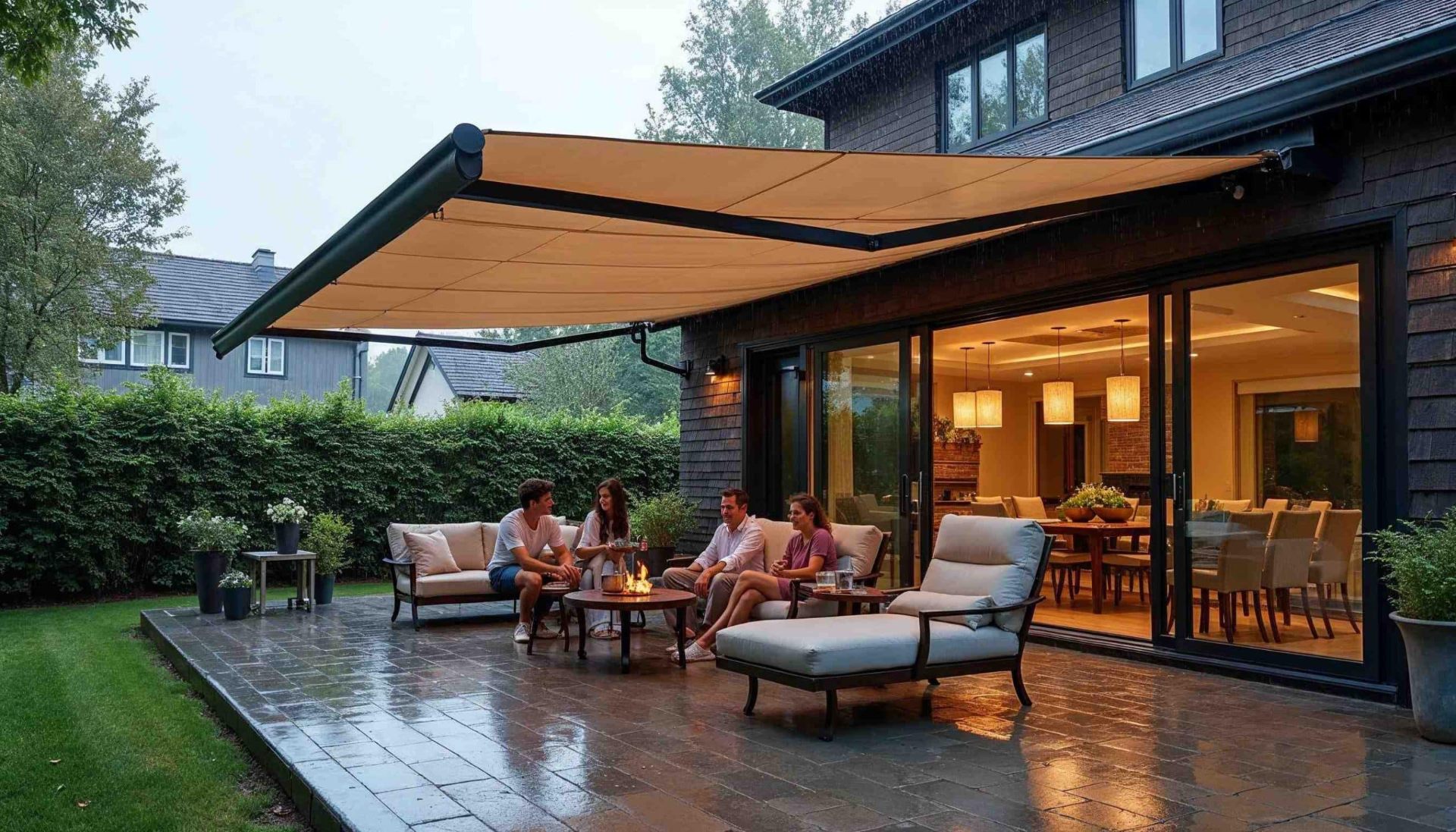
Are retractable awnings waterproof?
The short answer: modern awning fabrics are water resistant, not fully waterproof in the way a roof is.
Premium acrylic cloths - the sort we specify on every Aura installation - are woven from solution-dyed yarns and treated with a water-repellent finish. In practice, that means rain beads up on the surface and runs off rather than soaking in. During a light shower you'll stay perfectly dry underneath, and the fabric itself won't absorb the water.
The important distinction is this: water resistant means the fabric sheds rain well and can cope with the occasional downpour. Waterproof implies it's engineered to sit under prolonged, heavy rainfall indefinitely - which a retractable awning is not. Long, torrential rain will eventually find its way through seams, run down the wall, or - more importantly - build up on top of the fabric.
Can an awning stay open in the rain?
Yes, during light rain, absolutely. It's one of the small pleasures of owning one - sitting outside listening to a summer shower without getting soaked.
The key is the pitch of the awning. When we install one, we always set it to a slight downward angle so water runs off the front edge naturally rather than sitting on the fabric. Around 15 degrees is a widely accepted rule of thumb, and it's why a good installer will spend time getting this right rather than fixing the awning dead level.
If your awning is properly pitched, light rain will simply roll off the leading edge and drop harmlessly to the ground. You won't need to rush to retract it the moment the first drops fall.
What happens if water pools on an awning?
This is where things go wrong for people, and it's the single most common cause of avoidable awning damage.
If an awning is pitched too shallow, or if very heavy rain arrives faster than it can drain, water can start to collect on the fabric. Installers call this ponding, or standing water. It looks harmless enough - a small dip in the cloth that fills up like a shallow bowl - but water is deceptively heavy.
Water weighs roughly a kilogram per litre. On a 5 metre by 3 metre awning, even a modest pool a few centimetres deep can add well over 150kg of loading in a matter of minutes. That kind of weight was never in the design brief.
What breaks when this happens? Usually one or more of the following:
- The arms bend or twist out of alignment.
- The joints and elbows develop play or seize.
- The fabric stretches, sags permanently, or tears at the seams.
- The cassette distorts, so the awning no longer rolls in cleanly.
- The wall brackets are pulled downward, sometimes damaging the render or brickwork.
The frustrating part is that almost all of this damage is preventable with a bit of awareness.
What should I do if it starts raining heavily?
Retract it. Simple as that.
Modern motorised awnings make this a five-second job - a tap on the remote or a press on the wall switch and it's tucked safely back into the cassette. If you're at home and the sky is turning, close it early rather than waiting to see how bad it gets. It's always better to bring it in and re-deploy afterwards than to leave it out and hope.
Even manual crank models only take a minute or two to close. That minute is a lot cheaper than a set of replacement arms.
Can I close the awning when it's wet?
Yes - and sometimes you'll have no choice. If the rain is torrential and you need to protect the awning, you retract it wet.
The important step comes afterwards. Once the weather clears, extend the awning again and let the fabric dry naturally in the open air before rolling it back in. An hour or two in a light breeze is usually plenty.
If damp fabric is left rolled up inside the cassette for days or weeks, you can start to see mildew spots and staining develop on the cloth. It's not a fault with the awning or the fabric - any woven textile behaves the same way if stored wet - but it's easily avoided with this one habit.
How much wind can a retractable awning withstand?
This is the question that really matters, and the honest answer is: less than most people assume.
Awnings sold in the UK are rated to European wind classes under EN 13561. Without wading too deep into the technical detail, the classes work like this:
- Class 1 - suitable up to around 20-27 km/h (about 12-17 mph)
- Class 2 - suitable up to around 28-37 km/h (about 18-24 mph)
- Class 3 - suitable up to around 38-48 km/h (about 24-30 mph)
Most premium residential folding arm awnings - including the majority of the range we install - are certified to Class 2. That's roughly a fresh breeze on the Beaufort scale. In real-world terms, that's the point where:
- Small tree branches start to move noticeably.
- Shrubs and long grass sway.
- Loose paper, umbrellas and lightweight garden furniture become awkward to handle.
If the wind is noticeably tugging at your clothes or making an umbrella difficult to hold, that's roughly your ceiling.
Why gusts matter more than the average wind speed
Here's a subtlety that's easy to miss. The published wind class refers to a steady, sustained wind. It doesn't account for gusts, and gusts are where awnings tend to fail.
A helpful way to think about a deployed awning is as a large yacht sail cantilevered off the side of your house. When a strong gust hits, the entire surface catches that force at once and transfers it back through the arms, the cassette, and ultimately the wall brackets. A sudden 40 mph gust on a calm day can put far more load through the frame than a steady 25 mph wind ever would.
This is why our advice always errs on the cautious side. If gusts are forecast, bring it in - even if the average wind speed looks fine.
What happens if an awning is left out in strong wind?
At best, nothing. At worst, expensive damage:
- Bent or twisted arms that no longer sit flush when retracted.
- Distorted frameworks that throw the awning out of alignment.
- Broken brackets or fixings pulled from the wall.
- Torn or shredded fabric where the wind finds a weak point.
- Wall damage to render, brickwork or timber where the fixings tear out.
- Motor damage if the awning is being buffeted mid-cycle.
The good news is that all of this is entirely avoidable with basic awareness of the conditions - and, for many customers, with a small piece of technology.
Should I fit a wind sensor?
Honestly, for most people we'd say yes.
A wind sensor is a small device fitted to the front of the awning. It measures vibration and wind speed, and if it detects conditions above a set threshold, it automatically retracts the awning without you needing to do anything. Some models pair with sun sensors to deploy automatically when the sun comes out and retract when it clouds over or the wind picks up.
The customers who benefit most tend to be:
- Holiday homeowners who aren't always on site to react to changing weather.
- Busy families who might be out at work or on the school run when a storm rolls in.
- Homes with south or west-facing gardens that catch a lot of sun and exposure.
- Exposed locations - coastal properties, hilltops, or open countryside where wind arrives suddenly.
Wind sensors add a modest cost to the installation, and most customers we fit them for consider them cheap insurance against a much larger repair bill.
Can awnings be left out overnight?
We'd recommend retracting overnight as a matter of habit, for a few reasons.
British weather has a talent for changing character between 11pm and 6am. Wind that was a gentle breeze at bedtime can be gusting by dawn, and you're not there to react to it. Overnight dew and morning damp also leave the fabric sitting wet inside the cassette if the awning was rolled in early evening without a chance to dry.
The other golden rules:
- Always retract before leaving home, even for a few hours.
- Always retract before going on holiday. No exceptions.
- If you have a wind sensor, treat it as a safety net, not a substitute for closing the awning when you're away for extended periods.
Can snow or ice damage an awning?
Yes, badly. Never deploy a retractable awning in snow, ice or freezing conditions.
Snow is essentially the ponding problem multiplied. Even a light dusting of wet snow can weigh many kilograms per square metre, and if it settles and freezes on the cloth, you've created a very heavy, very rigid load sitting where a light, flexible fabric is supposed to be. It's a recipe for bent arms and torn fabric.
Retractable awnings are also not designed to be operated at freezing temperatures - fabric that's cold and stiff is much more prone to creasing and tearing as it rolls.
For most of our customers, the awning comes in for winter around November and stays retracted until spring. If yours is heavily used in the colder months, an infrared heater is a better answer than trying to keep the awning open.
Are awnings designed to stay open all the time?
This is worth being clear about, because it's where expectations sometimes drift.
A retractable awning is designed to be deployed when you want shade or shelter, and retracted when you don't. It's a shading product, first and foremost. It's not a roof.
If you want something that stays out permanently, in all weather, and copes with everything the UK climate can throw at it, you're looking at a different category of product entirely:
- A pergola with an integrated retractable roof.
- A fixed canopy built to structural load ratings.
- A glass room or veranda.
We install all of these too, and we're happy to talk through which is right for your space. But it's the wrong yardstick to hold a folding arm awning to.
How to maximise the lifespan of your awning
A well-made awning, looked after sensibly, will give you 10-15 years of service without drama. The habits that get you there are simple:
- Retract in strong wind. Learn where your comfort threshold is and stick to it.
- Avoid leaving it out in prolonged, heavy rain. Light showers are fine; sustained downpours aren't.
- Let wet fabric dry before rolling it back in.
- Keep it clean. A soft brush and warm water once or twice a season is plenty for most fabrics.
- Don't hang anything from the front rail - no lights, no baskets, no bunting. The arms aren't designed to carry point loads.
- Retract overnight where practical, and always when you leave home.
- Consider a wind sensor if you're often away or in an exposed location.
- Arrange occasional servicing. A quick check of fixings, brackets and moving parts every few years catches small issues before they become expensive ones.
None of this is onerous. It's the same common-sense care you'd give any premium outdoor product.
Frequently asked questions
Can an awning stay out in light rain? Yes. Provided it's installed with the correct pitch, light rain will run harmlessly off the front edge. It's one of the nicest ways to enjoy a British summer.
Can awnings handle heavy rain? No, not sustained heavy rain. The risk isn't the water itself but the weight of any water that pools on the fabric. In prolonged downpours, retract the awning.
Are awnings waterproof? Modern acrylic awning fabrics are highly water resistant - they repel rain and don't absorb water. They aren't waterproof in the sense of being designed to sit under continuous heavy rainfall.
Can strong wind damage an awning? Yes. Strong or gusting wind is the most common cause of awning damage. The safe operating window for most premium residential awnings is up to a fresh breeze - roughly 18-24 mph.
Can I leave my awning open all summer? Not permanently. Retract overnight and whenever you leave home, and always if wind or heavy rain is forecast. Beyond that, enjoy it as much as you like.
Should I retract my awning every night? Yes, as a matter of good habit. It protects against overnight weather changes and helps the fabric stay dry.
What happens if my awning gets wet? Nothing, as long as you extend it again in dry conditions and let the fabric dry out naturally before retracting. Storing it wet long-term can cause mildew staining.
Can snow damage an awning? Yes, severely. Never deploy in snow, ice or freezing conditions. Snow loading and frozen fabric are both major sources of damage.
How much wind is too much? As a general rule, if it feels windy enough to be unpleasant outside - branches moving, umbrellas struggling - it's time to bring the awning in.
Will a wind sensor protect my awning? It provides very good protection against sudden weather changes when you're not there to react. It's not a licence to leave the awning permanently deployed, but it's a valuable safety net.
The bottom line
A quality retractable awning is a beautifully engineered piece of kit designed to last for many, many years. The vast majority of weather-related damage we see is entirely preventable - and usually comes down to one of two things: leaving the awning out in weather it wasn't built for, or leaving it out when no one is home to react.
Retract it in strong wind. Retract it before heavy rain. Let the fabric dry when it's been out in a shower. Take it in overnight and before you leave the house. That's really the whole list.
Do those things, and your awning will look after you in return - shading long lunches, sheltering summer showers, and quietly transforming your outdoor space for a decade and more.
Like any good outdoor product, it performs at its best when it's used within its limits. Understand those limits and you'll enjoy it with confidence.
Thinking about an awning for your home or business? Our team surveys every project in person, specifies the right frame and wind class for your location, and installs to a standard we'd happily put our name to. Get a transparent, tailored estimate in under a minute.
Thinking about an awning of your own?
Get a transparent, tailored estimate in under a minute - no obligation.


