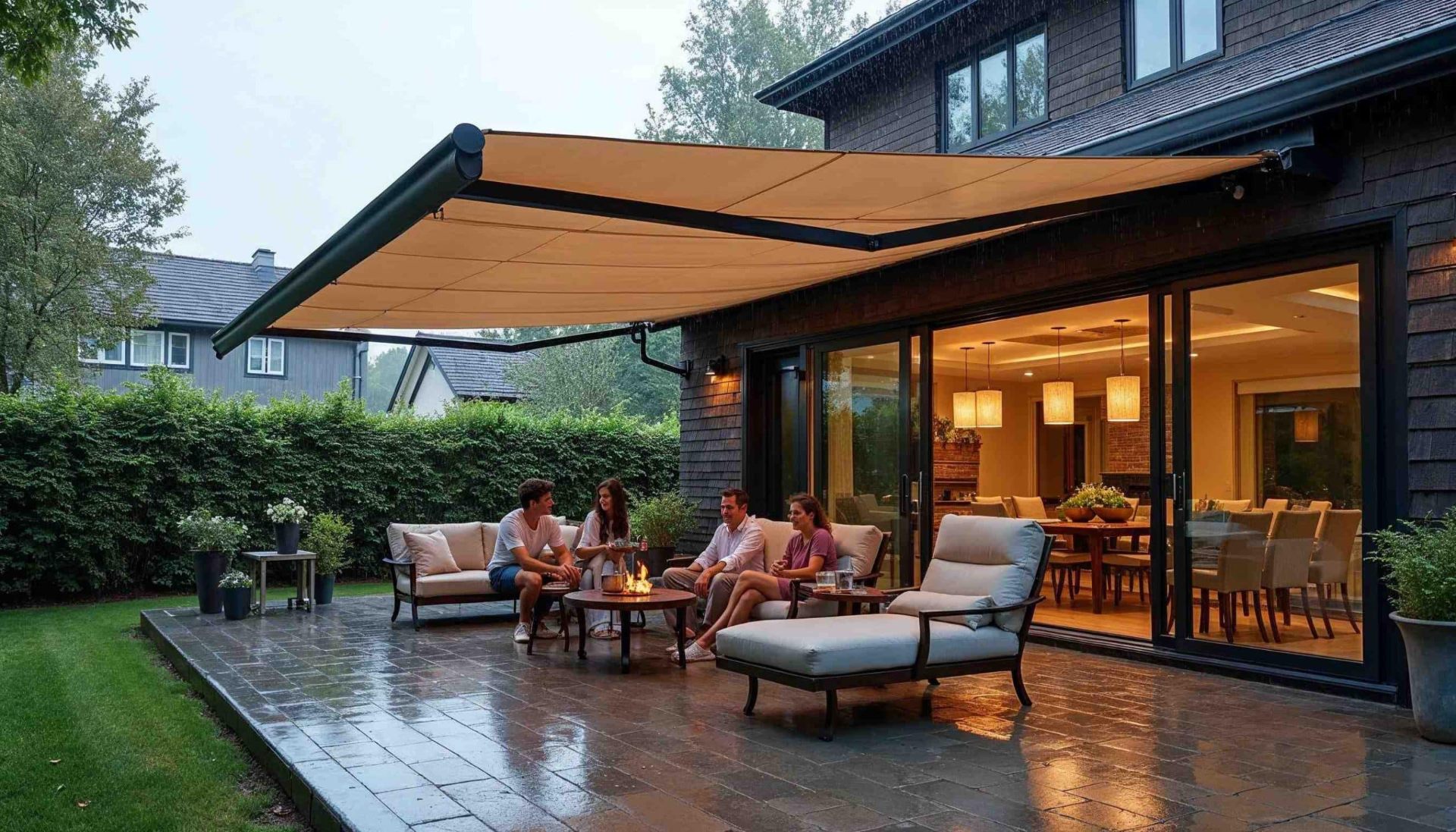
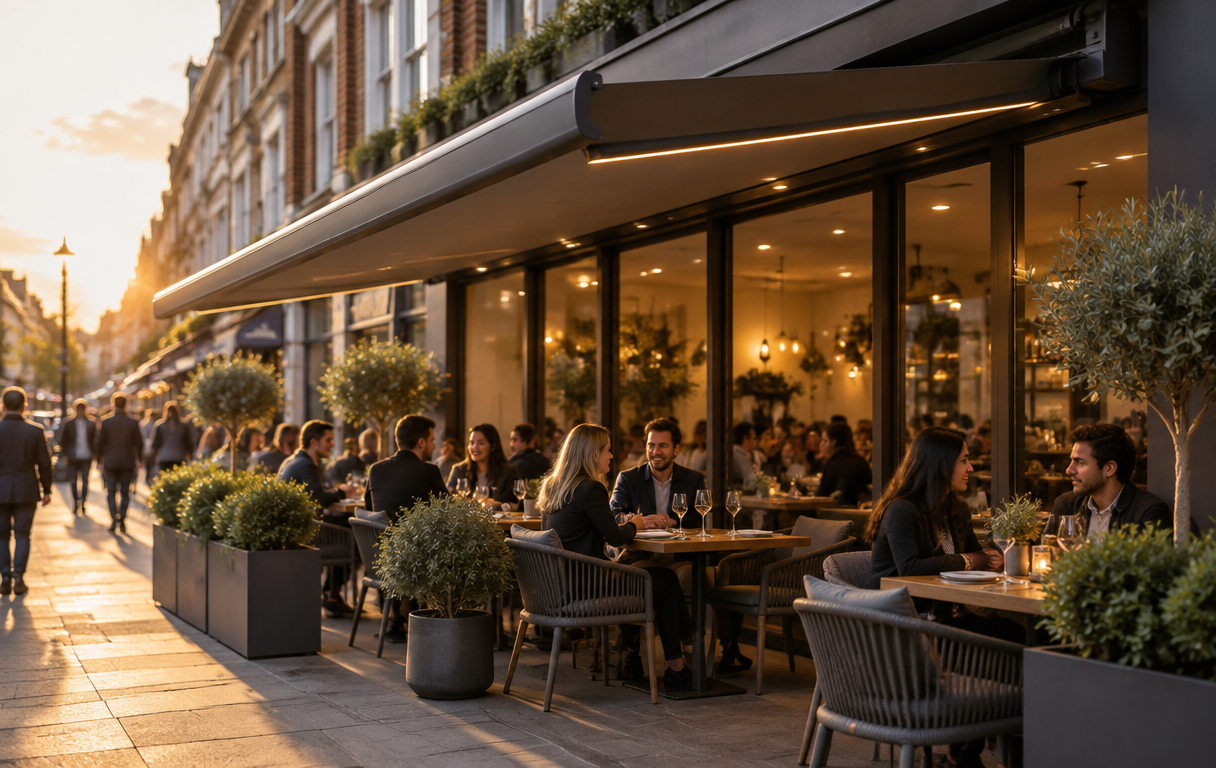
Every square metre of frontage counts for a restaurant, café or retail business. A commercial awning does more than keep the rain off - it creates usable outdoor space, frames your branding, and invites customers to stop before they've even read the menu.
For owners comparing custom shop awnings UK suppliers, the decision usually comes down to three things: how many extra covers the awning creates, how it performs in British weather, and how cleanly it integrates with the building. This guide covers all three, and explains why professional commercial awning supply fit matters for venues that trade every day.
Why restaurants and cafés invest in outdoor awnings
The hospitality businesses we work with - brasseries, independent cafés, wine bars and hotels - typically install awnings for one of three reasons:
- Extra covers, extra revenue. A 5m × 3m covered area can add 15-30 seats outside. Even at modest covers and spend, that unlocks tens of thousands of pounds in additional annual turnover.
- Weatherproof trading. A quality awning with the right pitch and wind rating lets you seat guests in light rain and bright sun, extending the months you can use the terrace.
- Curb appeal and branding. A bespoke commercial awning in your brand colour, with signwriting or a valance, turns a plain façade into a visible landmark on a busy street.
If you want a rough idea of what that could mean for your venue, our commercial awning revenue calculator estimates extra covers, potential turnover and indicative awning cost in under a minute.
Creating outdoor dining and drinking space
The most valuable thing a business awning does is convert pavement or courtyard into a controlled dining or drinking area. Done well, it feels like an extension of the interior rather than a temporary add-on.
What makes a commercial outdoor space actually usable?
- Generous projection. Most hospitality awnings project 3.0m to 3.5m to cover tables comfortably without guests feeling hemmed in.
- Integrated lighting. LED strip lighting in the arms or cassette lets the terrace trade into the evening and creates atmosphere after dark.
- Heating options. Infrared heaters, either wall-mounted or integrated, extend the season into spring and autumn.
- Clear sight lines. Open-sided awnings keep the venue visible from the street, unlike enclosed marquees or parasols that block the shopfront.
A good commercial awning makes the outdoor area feel intentional - not an afterthought.
Branded sign awnings and shopfront impact
For retail and hospitality alike, storefront awnings act as signage. A full-cassette awning in a strong colour, with your logo or name on the valance, is visible from further down the street than a window sticker and far more polished than a freestanding umbrella.
Our bespoke commercial awnings can be finished with:
- Powder-coated cassette and arms in almost any RAL colour to match your brand.
- Signwriting and logos applied to the valance or fabric.
- LED lighting to highlight the brand and seating area at night.
- Custom bracketry for curved façades, listed buildings and awkward reveals.
The result is a shopfront that looks established and intentional, not weather-beaten or improvised.
Weather protection customers can trust
British weather is changeable, so a hospitality awning needs to work reliably across four seasons. That means specifying for real conditions, not just sunny days.
Rain and pitch
Commercial acrylic fabrics are water resistant and shed light rain well, but the awning must be pitched correctly - typically around 15 degrees - so water runs off the front edge rather than pooling. Pooling water adds enormous weight quickly and is one of the most common causes of awning damage.
Commercial wind ratings
All awnings sold in the UK are classified under EN 13561. For commercial use, we typically specify models rated to Class 2 or Class 3, which cope with fresh to strong breezes. In exposed locations or on upper floors, we recommend wind sensors that automatically retract the awning when gusts pick up.
| Wind class | Approximate wind speed | Real-world guide |
|---|---|---|
| Class 1 | 20-27 km/h | Light breeze, leaves rustle |
| Class 2 | 28-37 km/h | Fresh breeze, small branches move |
| Class 3 | 38-48 km/h | Strong breeze, larger branches in motion |
Choosing the right wind class, and adding sensors where needed, protects the awning and keeps your outdoor space safe for guests and staff.
Planning permission for commercial awnings
Most ground-floor commercial awnings fall under permitted development in England and Wales, provided they project no more than 3 metres from the building and don't significantly alter the frontage. Listed buildings, conservation areas and upper-floor projections usually need extra consent.
We always recommend checking with your local planning authority before ordering. As part of our commercial awning supply fit service, we can advise on typical requirements and provide drawings if needed.
You can read more in our full guide: Do I Need Planning Permission for an Awning in the UK?.
Why professional supply and fit matters for businesses
A commercial awning is a working piece of building equipment. It sits outside all year, carries wind loads, and needs fixings that match the actual wall construction - whether that's Victorian brick, modern thermal block, steel frame or rendered timber.
DIY or budget installations on commercial buildings frequently fail at the fixings: bolts pull out of soft block, brackets flex, or the awning sits out of square so the fabric and arms wear unevenly. When that happens, the repair usually costs more than the original fitting, and the downtime costs you trading days.
A professional awning company UK approach - and the mark of a best shop awning supplier - means:
- Site survey and load assessment before quoting.
- Correct brackets and anchors for the wall type.
- Clean electrical hookup for motors, sensors and lighting.
- Programming of limits and safety features.
- Warranty and aftercare from one accountable supplier.
For venues that rely on outdoor seating, that's the difference between an asset that earns and one that spends.
What to expect from Aura Awnings
We work with restaurants, cafés, bars and retailers across London and the South East. Our process is designed around minimal disruption to trading:
- Free site survey - measurements, wind exposure, branding discussion and an honest assessment of the wall.
- Itemised quote - awning, fabric, fixings, lighting, heating and installation, with no hidden extras.
- Made-to-order manufacture - typically 2-3 weeks for standard specifications.
- Installation - led by Simon and our experienced team, often completed in a single day.
- Handover and warranty - controls training, limits set, warranties registered.
Calculate the business case for your venue
If you're weighing up whether a business awning is worth the investment, start with the numbers. Our commercial awning revenue calculator lets you model extra covers, average spend, trading days and indicative awning cost, then request a free consultation if the projections look promising.
Book a free site survey and we'll survey your shopfront properly - or start with an estimate to explore options and pricing.
Thinking about an awning of your own?
Get a transparent, tailored estimate in under a minute - no obligation.