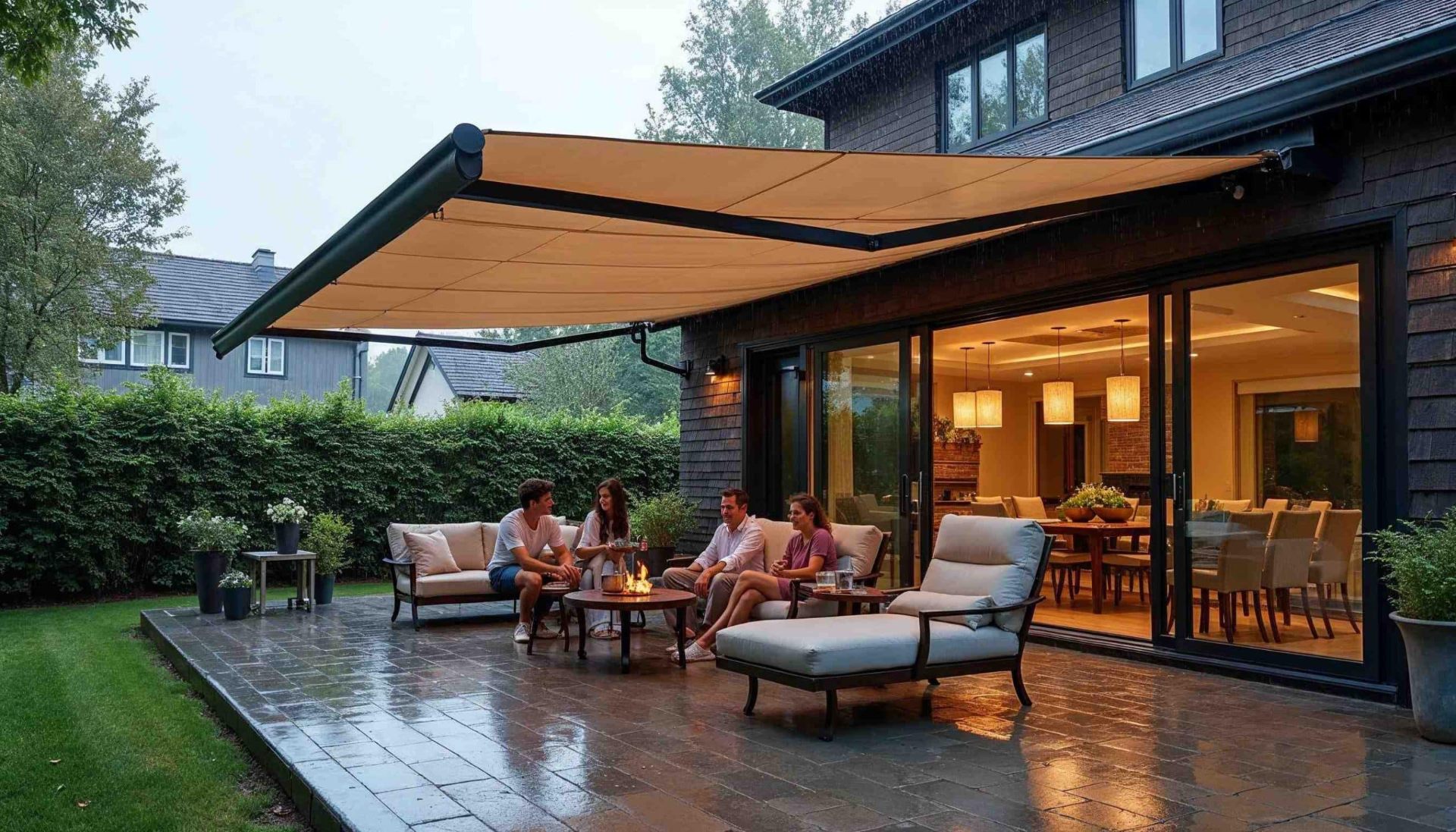
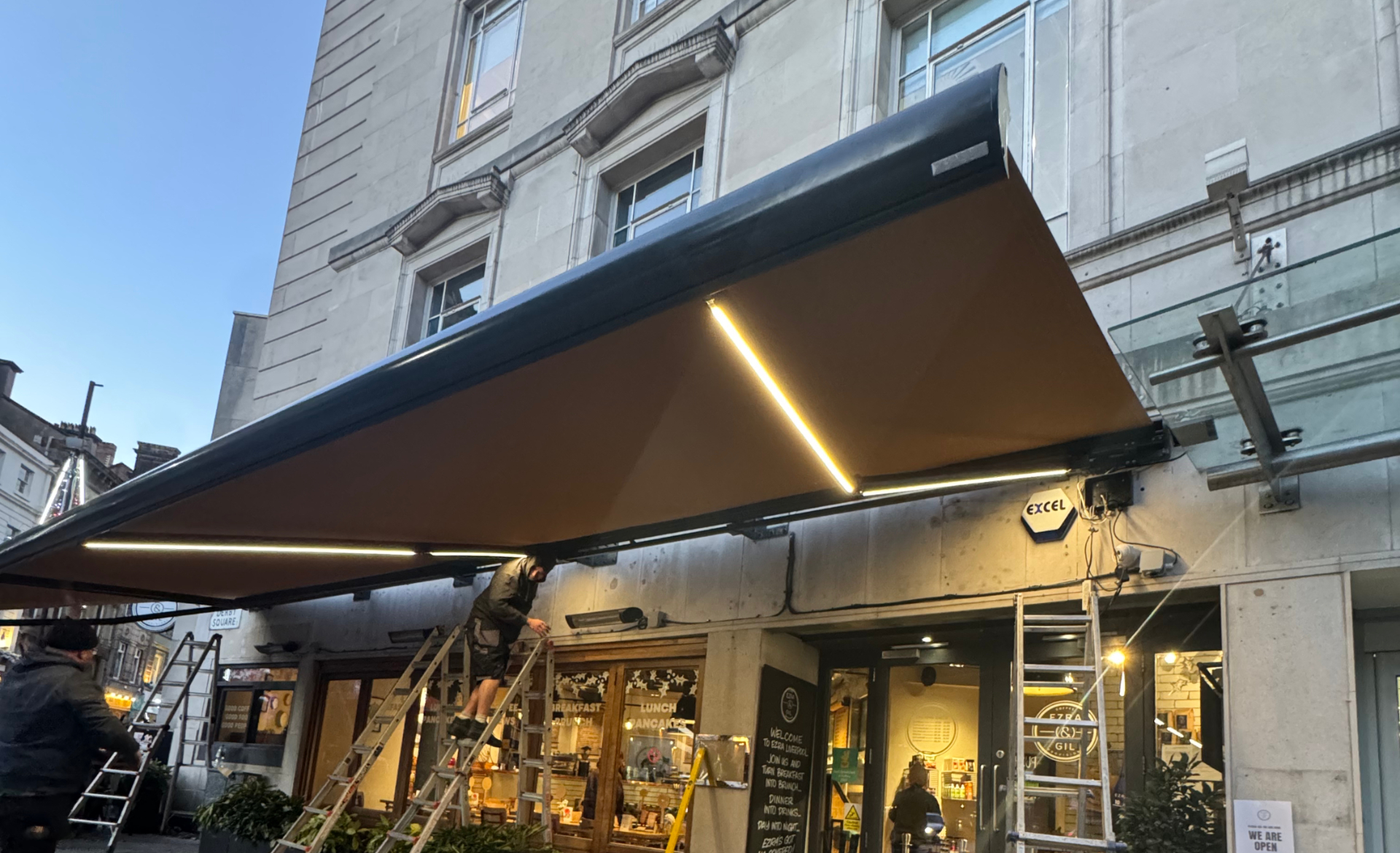
Search for awning installers near me and you'll find two very different offers: companies who supply and fit your awning end-to-end, and suppliers who ship you a box and wish you luck. On paper the DIY route can look like a saving. In practice, it's the single most common reason we're called out to rescue a failed installation.
This guide explains what a professional awning supply and fit service actually includes, why it matters for safety and warranty protection, and what our own installation team checks on every single job.
Meet the team: 30+ years of awning installation experience
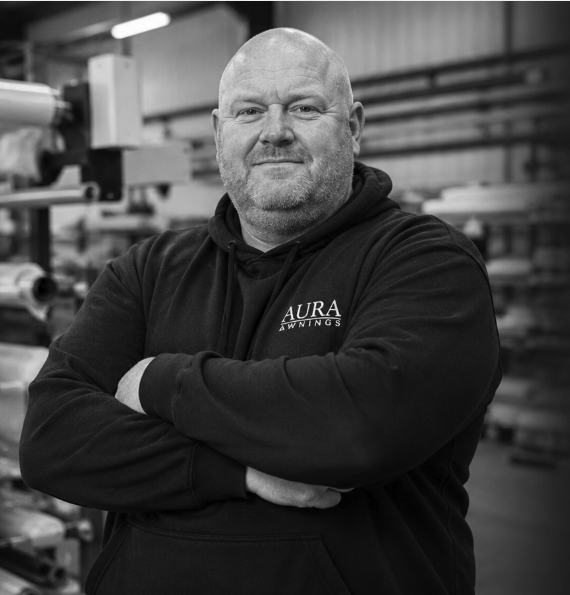
Our installations are led by Simon, who has been fitting awnings for over three decades. In that time he's installed on just about every wall type the UK has to offer - Victorian London stock brick, modern thermal block, rendered extensions, steel-framed shopfronts and everything in between.
That experience matters because an awning is not a shelf bracket. A 5 metre motorised awning can weigh 80-100kg, sits under constant spring tension, and catches the wind like a sail. Where and how it's fixed is an engineering decision, not a guess - and it's the part of the job you absolutely cannot see once the cassette is on the wall.
What professional supply & fit actually includes
When you buy from a genuine awning company in the UK that supplies and fits, you're paying for a chain of decisions that happen before, during and after installation day:
1. A proper site survey
Before we quote, a director surveys the property in person. We're checking:
- Wall construction - solid brick, blockwork, render over thermalite, timber frame or steel. Each needs a completely different fixing strategy.
- Structural position - where the load can actually go, avoiding lintels, cavity zones, pipework and weak mortar beds.
- Height, width and projection - measured to the millimetre, checked against door swings, soffits, gutters and head-height clearance.
- Sun aspect and wind exposure - which dictates pitch, wind class and whether sensors are essential.
A DIY buyer is measuring with a tape and hoping. Our surveyors are deciding whether the wall can safely take the load - and what to do if it can't.
2. Brickwork checks and the right fixings
This is where DIY installations most often fail. Modern UK walls are frequently built with thermal blocks (aerated concrete blocks like Thermalite) behind the outer leaf. Standard expansion bolts in thermal block simply pull out under awning loads - sometimes weeks after installation, often in the first gust of wind.
Our team carries the correct fixings for every wall type:
- Resin anchors and chemical fixings for soft stock brick and lime mortar.
- Through-fixings and spreader brackets that bridge back to structural masonry when the outer leaf is weak.
- Purpose-fabricated brackets for awkward reveals, pipes, gutters and curved façades.
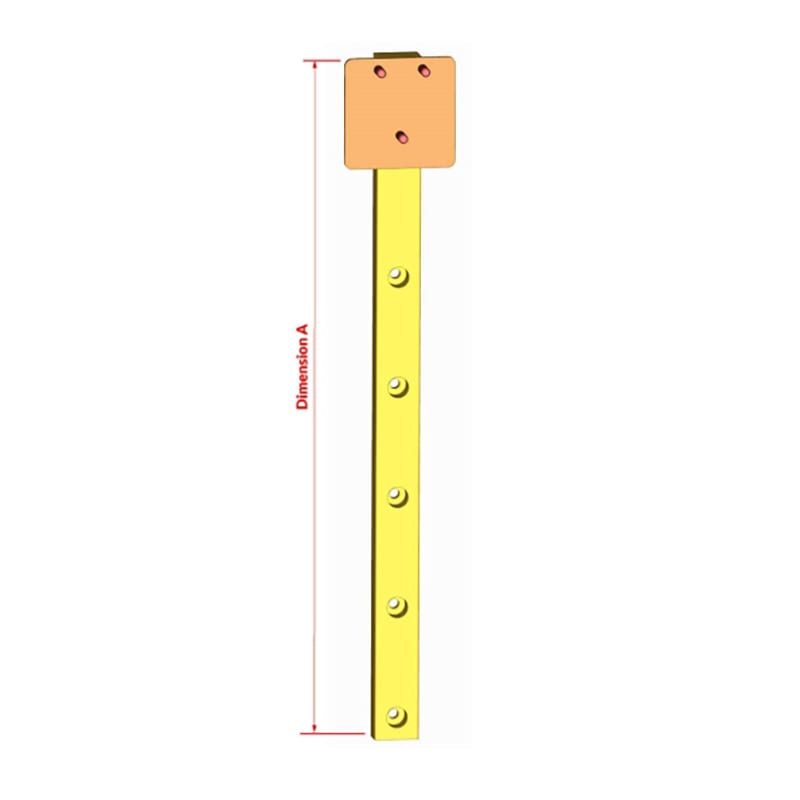
We drill test holes, check what's actually behind the render, and fix accordingly. It's invisible in the finished job - and it's the difference between an awning that lasts 20 years and one that ends up on the patio.
3. Pitch alignment and geometry
A folding-arm awning must be set at the correct pitch - typically around 15 degrees - so rainwater runs off the leading edge rather than pooling on the fabric. Pooling water adds enormous weight (over 150kg on a large awning in minutes) and is the most common cause of bent arms and torn fabric.
Getting pitch right means the brackets must be set dead level and square first, then the arm geometry adjusted precisely. On uneven brickwork or out-of-square openings this takes experience and patience - it's not something you can eyeball from a ladder.
4. Electrical hookups, done safely
Most premium awnings are motorised, with Somfy motors, remote controls and optional wind-and-sun sensors. The electrical side needs:
- A correctly rated, fused supply run by a qualified electrician.
- Motors programmed with accurate upper and lower limits - set wrong, the motor strains against the stops and burns out early.
- Sensors mounted, paired and tested so the awning retracts itself before the wind does damage.
We coordinate the whole thing: our team fits and programmes the motorisation, and we'll work with your electrician or arrange a trusted local one so the power is ready for installation day.
5. Warranty protection you can actually use
Here's the part most DIY buyers discover too late: manufacturer warranties are conditional on professional installation.
At Aura, your awning carries up to a 5-year guarantee on the frame and motor, a 10-year guarantee on the fabric, and a 12-month installation guarantee covering our workmanship. If an authorised specialist didn't fit it, those protections can be void - and when a DIY-fixed awning damages the wall on the way down, your home insurer may take a similar view.
Professional supply and fit means one accountable company for the whole job: product, fixings, electrics and aftercare.
The true cost of DIY
A premium awning is a considered investment - usually several thousand pounds. The typical DIY failure costs look like this:
- Awning pulled from the wall: replacement brackets, masonry repair, re-render and re-decoration - often £500-£1,500 before the awning itself is looked at.
- Bent arms or twisted cassette from bad geometry: arms are not cheap, and some damage means a new unit.
- Voided warranty: you carry the full cost of every future failure.
- Do-it-twice fitting: paying a professional team to remove, repair and refit costs more than having them fit it first.
The saving on a DIY install is typically a few hundred pounds. The risk is the whole investment.
What to expect from an Aura installation
- Free on-site survey with a director - wall checks, measurements, honest advice.
- Itemised written quote - frame, fabric, motor, fixings and installation, no surprises.
- Made-to-measure manufacture in the UK, typically 2-3 weeks.
- Installation day - Simon and the team arrive with the right fixings for your wall. Most residential installs complete in a single day.
- Handover - full walkthrough of controls, sensors and care, with warranties registered.
- Aftercare - we're on the end of the phone for the lifetime of your awning.
Looking for awning professionals near you?
We supply and fit premium awnings across London and the South East, with every installation led by Simon and backed by our full guarantee package.
Book a free site survey and we'll come and look at your wall properly - or start your estimate in under a minute.
10 Things To Know Before Buying A Premium Awning
Thinking about an awning of your own?
Get a transparent, tailored estimate in under a minute - no obligation.